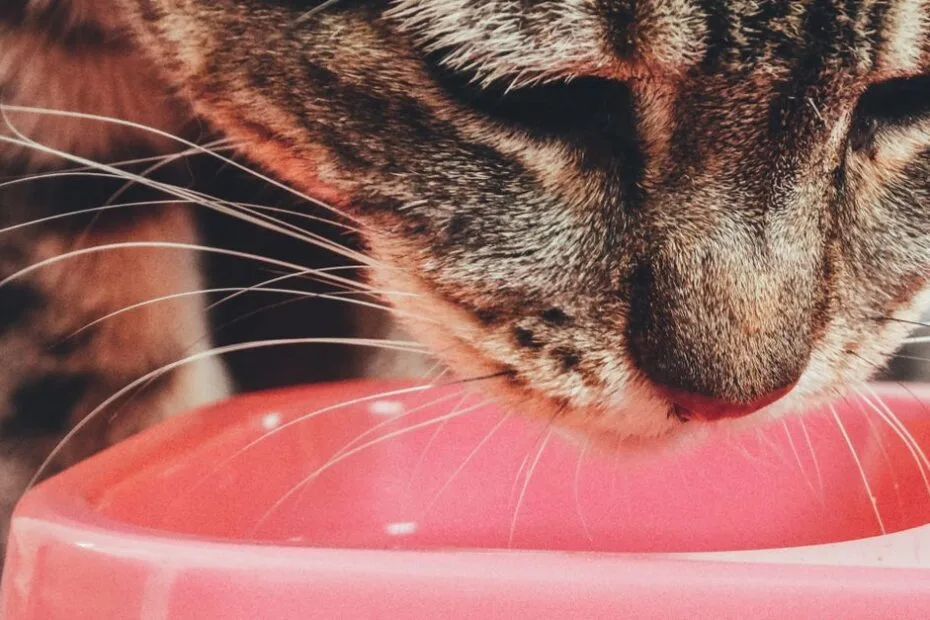
How much to feed a cat: a typical healthy adult cat needs roughly 25–35 calories per pound of body weight per day — about 200–250 calories for the average ten-pounder, which translates to LESS food than almost everyone pours (a quarter-cup of many dry foods twice daily, or roughly a 5.5-ounce can-and-a-bit of wet) — but the honest answer is that the NUMBER on any chart, this one included, is a starting point that individual cats miss by up to fifty percent in either direction, which is why the real instrument isn’t a measuring cup but the BODY-CONDITION CHECK: ribs feelable under a thin fat layer like the back of your hand, a visible waist from above, a belly tuck from the side — run monthly, adjusted by ten-percent moves. The delivery rules matter as much as the amount: MEALS beat free-feeding (cats are hunters built for several small successes a day, not grazers — and the always-full bowl is the quiet engine of the indoor-cat obesity epidemic), treats stay inside ten percent of the day’s calories, and every number on this page bends to your vet’s — especially for kittens, seniors, and any cat whose weight is already a project.
This is the complete feeding guide: the calorie math made usable (and where to find your cat’s real number), the body-condition check that outranks every chart, meal-feeding versus free-feeding settled, the wet-versus-dry-versus-both decision, portion mechanics (why the measuring scoop lies and the kitchen scale doesn’t), the kitten and senior calibrations, the multi-cat separation problem, the weight-loss protocol done safely (and the crash-diet danger unique to cats), and the appetite red flags that are vet calls, not menu reviews.
Key Takeaways
- Start near 25–35 calories per pound per day — then let the monthly body-condition check, not the chart, set the number.
- Meals beat free-feeding: two-to-three scheduled feedings fit the hunter, protect the waistline, and make appetite a readable health signal.
- Measure by GRAMS on a kitchen scale — the eyeballed scoop runs 20–50% heavy, and calorie density varies wildly between foods.
- Treats live inside 10% of daily calories — they’re a budget line, not a bonus.
- Never crash-diet a cat: rapid weight loss risks hepatic lipidosis. Slow, vet-guided cuts only.
- Appetite changes in either direction are health reports — a cat off food for more than a day is a vet call.
The Calorie Math (Made Actually Usable)
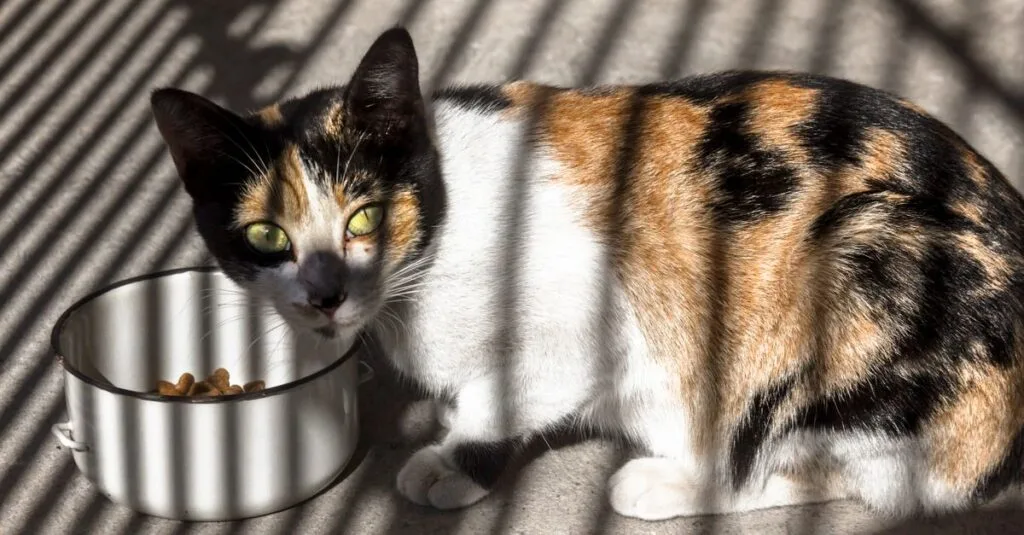
THE STARTING NUMBER: 25–35 calories per pound of IDEAL body weight — note the word ideal, because feeding the overweight cat’s current weight locks the problem in; a lean 8-pound cat runs ~200–280, the classic 10-pounder ~250–350 at the active end and closer to 200 for the couch tier, and indoor-neutered adults — most of this site’s readership — sit at the LOW end of every range because spay/neuter drops energy needs while appetite stays enthusiastic.
Also Read




WHERE THE REAL NUMBERS LIVE: the bag or can’s kcal/cup or kcal/can line (calorie density varies two-fold between foods — the same scoop of two kibbles can differ by a hundred calories, which is why “a cup a day” means nothing brandless), and your vet’s math at the annual visit, which accounts for the age, activity, and body-condition dials no internet chart can see; the water-intake habit pairs with this as the other half of the intake dashboard.
THE LABEL TRANSLATION: feeding-guide tables on packaging are written for the RANGE of cats, skew generous, and assume unneutered activity levels — treat them as a ceiling, not a prescription, start at the low end, and let the monthly check below adjudicate; ten-percent moves every few weeks, never dramatic cuts.
The video above is Jackson Galaxy on the feeding mistake most households make — the always-full bowl — and the meal-feeding case below is his argument plus the medical one.
The Body-Condition Check (The Instrument That Outranks Charts)
THE THREE-POINT EXAM, thirty seconds monthly: RIBS — run flat fingers along the ribcage; feelable under a thin cushion (like the back of your hand) is right, washboard-visible is thin, requires-pressing is heavy; WAIST — from above, an hourglass tuck behind the ribs (straight sides mean heavy; the primordial pouch swinging low is normal cat architecture and NOT the same thing); PROFILE — from the side, a belly line that rises toward the hips rather than sagging level.
THE ADJUSTMENT PROTOCOL: heavy reads cut the daily grams by ten percent and re-check in three-to-four weeks, thin reads add the same, and the log line (“March: 62g/day, ribs OK, waist soft”) turns feeding into the same trend-line instrument as every monitoring habit on this site — cats change slowly, and the notebook sees what the eye that lives with them can’t.
THE SCALE UPGRADE for the serious: a monthly weigh-in (cat-in-carrier on a bathroom scale, minus carrier — or the baby-scale tier for precision) catches drift the hands miss, and a half-pound move on a ten-pound cat is five percent of the animal — the human equivalent of eight pounds appearing unannounced.
Meals vs. Free-Feeding (Settled, With the Exceptions)
THE CASE FOR MEALS: cats are built to hunt, catch, and eat several small victories a day — scheduled feedings (two minimum, three where schedules allow) fit that wiring, keep calories countable, make APPETITE VISIBLE (the free-fed household discovers the sick cat days late, because nobody notices a communal bowl going down slower), and anchor the routine that every behavior guide on this site leans on; the always-full bowl, by contrast, is boredom eating with a dispenser.
THE MECHANICS: fixed times (cats set watches by meals — expect enforcement), food down twenty-to-thirty minutes then lifted, water always available everywhere, and the hunt upgrade for the enthusiastic: puzzle feeders and treat balls convert a bowl-minute into twenty minutes of licensed hunting — the single cheapest enrichment purchase in the catalog.
THE HONEST EXCEPTIONS: the underweight senior who needs every calorie welcome, the multi-cat detente where one grazer keeps peace (better solved with separation, below), and medical plans your vet sets — free-feeding isn’t a moral failure, it’s just the wrong default for the average indoor adult.
Wet, Dry, or Both (The Format Decision)
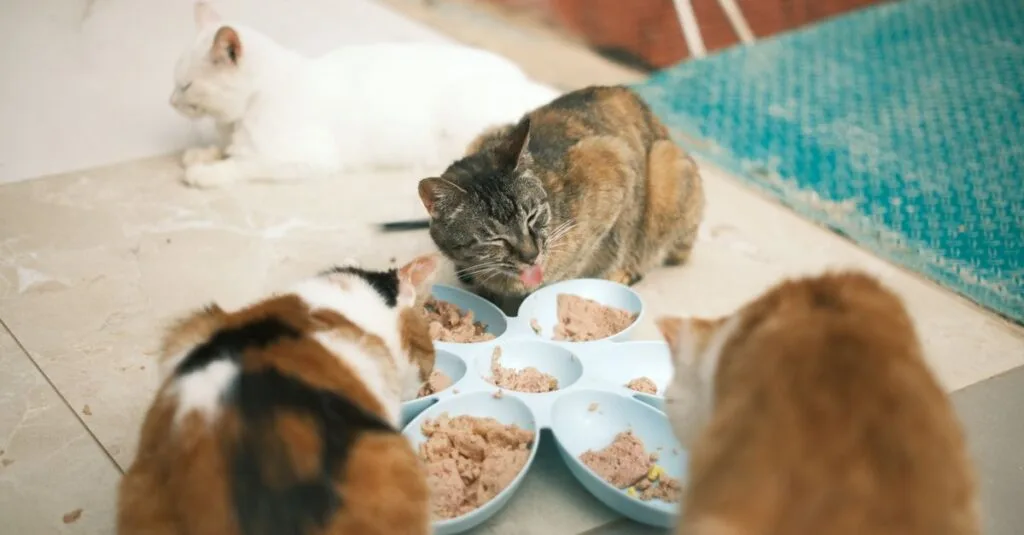
THE TRADE HONESTLY STATED: WET food carries water (70%+ moisture — meaningful for a species that under-drinks by design, and the urinary-health argument many vets make), portion-controls naturally by can, and costs more per calorie; DRY is economical, convenient, puzzle-feeder-compatible, and calorie-DENSE (the free-fed dry bowl is the obesity story in one image); the BOTH strategy — wet meals anchoring the day, measured dry as the smaller share — is the popular middle for good reason.
THE PICKING RULES live elsewhere on this site: AAFCO adequacy first, life-stage match, and the label literacy the product framework teaches — the wet-food and dry-food guides carry the roundup work, and the fountain tier in the hydration guide supports whichever format you land on.
THE TRANSITION RULE for any format or brand change: 25% new stepped up over seven-to-ten days — cat stomachs punish abrupt switches, and the transition is also your palatability audit; a cat who eats around the new food is casting the same vote the litter guide taught you to count.
Kittens, Seniors, and the Multi-Cat Problem
THE KITTEN CALIBRATION: growth runs on different math entirely — kittens eat MORE per pound than adults (their energy needs peak at two-to-three times adult rates), on kitten-labeled food, in three-to-four daily meals through the first months, with the kitten-food guide carrying the picks; the switch to adult food and adult math lands around the first birthday, vet-timed for the big breeds.
THE SENIOR DIALS: older cats drift both directions — some thicken on unchanged portions as activity drops, while the oldest tier often LOSES weight (dental pain, fading smell, and the disease trio the water guide maps) — so the body-condition check gains importance with every birthday, weight loss on unchanged food is a vet flag rather than a diet success, and warming wet food unlocks appetite in the fading-smell tier.
THE MULTI-CAT SEPARATION: shared bowls hide every signal this guide relies on — who eats, how much, how fast — and feed the fastest cat twice; the fix is stations apart (separate rooms for the contested cases), meal times enforced, and the microchip-feeder tier for households where one cat needs a prescription diet the other would happily steal.

The Weight-Loss Protocol (And the Crash-Diet Danger)
THE SAFE SLOPE: overweight cats lose weight on a vet-set plan at roughly one-to-two percent of body weight per WEEK maximum — slow is the entire method — via measured-gram cuts, wet-leaning menus (volume and water for fewer calories), and hunger management through puzzle feeders and meal-splitting rather than willpower (cats don’t have any, and neither do the humans they yell at).
THE DANGER PARAGRAPH this topic requires: a fat cat who stops eating — because the food was cut too hard, the new diet food was refused, or illness intervened — can develop HEPATIC LIPIDOSIS (fatty liver) within days, a genuinely life-threatening cascade unique to cats; this is why crash diets are never on the table, why “he’ll eat when he’s hungry” is dangerous advice for cats specifically, and why any dieting cat who refuses food for more than a day is a same-week vet call.
THE PAYOFF FRAME: even a pound off an overweight cat measurably improves mobility, grooming reach, and diabetes risk — the leanest honest framing is that portion control is the cheapest longevity intervention in feline medicine, and it costs a kitchen scale.
Appetite Red Flags (Menu Review vs. Vet Call)
THE VET-FIRST LIST: a cat OFF food for more than 24 hours (the lipidosis clock above makes this cat-specific and non-negotiable), appetite UP with weight DOWN (the classic hyperthyroid signature in middle-aged-plus cats), ravenous-plus-thirsty (the diabetes pairing the water guide flags), eating approaches then retreat (dental pain’s signature move), and vomiting beyond the occasional hairball economy.
THE PICKINESS DECODE, for calibration: true feline pickiness exists (texture and shape opinions are real), but SUDDEN pickiness in a previously reliable eater is a symptom wearing a preference costume — the same sudden-change rule that governs every behavior guide here — and the three-day food-refusal standoff the internet recommends for dogs is, for cats, a medical gamble nobody should take.
THE MEAL-FED ADVANTAGE, closing the loop: every flag above surfaces in DAYS in a meal-fed household and in WEEKS in a free-fed one, because the empty-or-not bowl at 6 p.m. is a daily health report — the schedule isn’t just portion control; it’s the monitoring instrument.

Frequently Asked Questions
How much should I feed my cat per day?
Start near 25–35 calories per pound of ideal body weight — roughly 200–250 calories for an average indoor ten-pounder — using the kcal line on your food’s label, then adjust by ten-percent moves based on the monthly body-condition check. Individual needs vary up to 50%, so your vet’s number outranks any chart.
How many times a day should a cat eat?
Two-to-three scheduled meals beats free-feeding for most indoor adults — it fits the hunter’s wiring, keeps calories countable, and makes appetite a readable health signal. Kittens eat three-to-four meals; food goes down for 20–30 minutes, water stays out always.
Is wet or dry food better for cats?
Wet carries water a low-thirst species genuinely needs and portion-controls by can; dry is economical and puzzle-feeder-friendly but calorie-dense. The popular middle is wet meals anchoring the day with a measured dry share — and AAFCO adequacy plus life-stage match matter more than format ideology.
How do I know if I’m feeding my cat the right amount?
Run the monthly three-point check: ribs feelable under a thin layer, a waist visible from above, a belly line that rises toward the hips. Heavy reads cut portions ten percent; thin reads add ten — and a monthly weigh-in catches the drift hands miss.
Why shouldn’t you put an overweight cat on a crash diet?
Because a cat who stops eating can develop hepatic lipidosis — life-threatening fatty liver — within days. Feline weight loss runs at one-to-two percent per week maximum on a vet-set plan, and any dieting cat refusing food for more than a day is a same-week vet call.
When is a cat’s appetite change a vet problem?
Off food past 24 hours (always, in cats), eating more while losing weight (hyperthyroid signature), ravenous plus thirsty (diabetes pairing), approaching food then retreating (dental pain), or sudden pickiness in a reliable eater — all vet calls before menu experiments.
The Bottom Line
Feed to the body, not the bag: start low in the 25–35-per-pound range, weigh grams instead of eyeballing scoops, serve it as meals a hunter would recognize, split formats to get water in, calibrate for kittens and seniors, separate the multi-cat bowls, lose weight only slowly and never let a cat skip days — and read every appetite change as the report it is.
The measuring cup was never the instrument. The cat is — ribs, waist, and the 6 p.m. verdict on an empty bowl.

Hello! I'm Khan Hisham, a dedicated student with a profound passion for enhancing the lives of pets through comprehensive care. At Pawspera, our mission—"Prospering Pets, Every Day"—drives everything we do. We are committed to providing the latest insights, tips, and products that ensure your pet's health and happiness. Join us at Pawspera as we explore innovative ways to care for our furry friends with love and dedication.