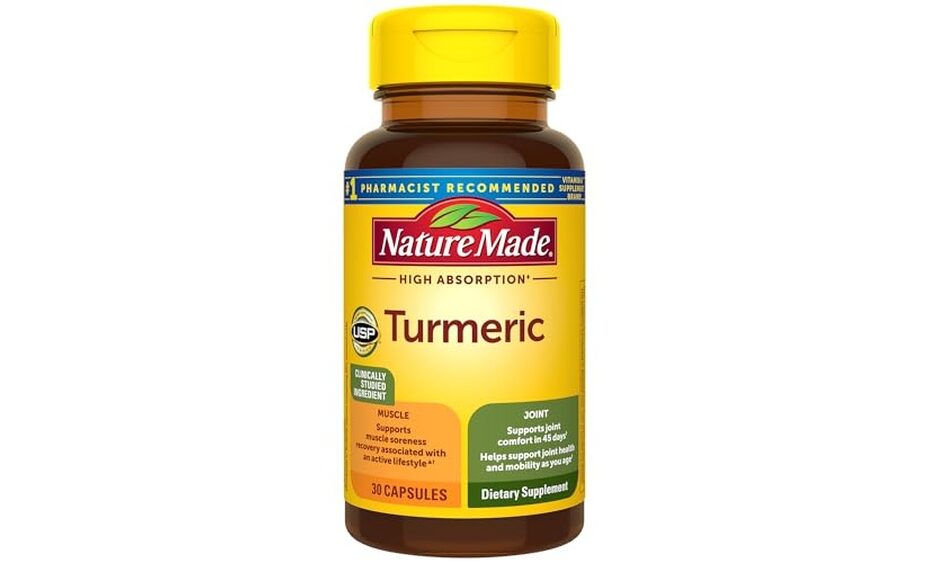
“High absorption” on turmeric curcumin capsules describes a formulation claim. It does not establish better symptom relief, a safe dose for you, or a reason to replace medical treatment. Check the exact ingredients, the evidence behind the claim and the safety questions before comparing products.
Scope: This is a source-based guide to human supplements for adult readers. It contains no brand ranking, hands-on test or pet dosage advice. A doctor or pharmacist should review a proposed supplement if you have symptoms, take medicines or have an existing health condition.
What is the difference between turmeric and a curcumin supplement?
Turmeric is a plant used as a food spice. Curcumin is one of its constituents. A capsule may contain root powder, an extract, a specified quantity of curcuminoids, or a blend with other ingredients. Those descriptions cannot be treated as interchangeable quantities.
The NCCIH turmeric overview says evidence is insufficient for definitive conclusions about health benefits. Some findings for knee osteoarthritis are encouraging, but that does not establish reliable benefit for every formulation or other condition.
Start with the label rather than a promise about inflammation, digestion or immunity. The useful question is what was actually studied and whether the same formulation is being sold. A familiar spice name should not make the rest of the ingredient panel invisible.
Does greater absorption mean greater benefit?
An absorption study and a clinical benefit study ask different questions. The first might measure how much of a substance appears in blood after a dose. A clinical study might ask whether people can perform daily activities more comfortably. A result from one kind of study should not be described as the result of the other.
When a label claims many times greater absorption, ask what the comparison was: ordinary powder, a different extract, or the same ingredient without an added component. Also ask whether the measurement came from people, an animal experiment or a laboratory procedure.
Record the answer in plain words. “Higher blood concentration than a named comparator” is a narrower statement than “works better.” If the seller does not provide enough information to identify the comparison, do not use its multiplier to rank products.
What safety concerns should be considered first?
NCCIH reports digestive side effects and cases of liver injury associated with some formulations designed for increased bioavailability. It also advises caution about use during pregnancy. If you develop dark urine, jaundice, poor appetite or other possible liver symptoms while taking turmeric or curcumin, stop the product and contact a healthcare professional.
The Australian Therapeutic Goods Administration also describes a rare liver-injury risk with medicinal turmeric or curcumin products, with potential concerns around enhanced absorption. This does not mean every user will have a problem. It means a guide should not promise that a concentrated product is gentle or safe for everyone.
Bring the whole ingredient panel to a pharmacist. Added black pepper extract, ginger, other botanicals or vitamins need to be included in the review. Do not present a multi-ingredient capsule as though it contains only a kitchen spice.
How do you decode the quantity on the front label?
Copy the serving size first. Then identify which number refers to root powder, which refers to extract, and which refers to curcuminoids. A front label may emphasize a large total while the Supplement Facts panel separates several components.
Illustrative arithmetic, not a real product or dose recommendation: If a hypothetical extract amount is 200 mg and the label states that this extract is standardized to 50% curcuminoids, the implied curcuminoid amount is 100 mg. Adding 800 mg of ordinary root powder does not turn the entire 1,000 mg mixture into 1,000 mg of curcuminoids.
Do not perform that calculation when the label does not clearly identify what the percentage applies to. Write “unclear” and request clarification. An impressive number is not useful when its denominator is missing.
Keep “per capsule” and “per serving” separate. Two products can display the same amount while requiring different numbers of capsules. That difference affects package duration and price comparisons even before any health question is considered.
What belongs on a product comparison sheet?
- Exact product name, seller and date checked.
- Serving size and number of servings in the package.
- Root powder and extract amounts, listed separately.
- Any stated curcuminoid amount or percentage.
- Every added ingredient used to describe the formulation.
- A link to the evidence behind an absorption claim.
- Warnings, expiry information and a readable batch identifier.
- Questions that remain unanswered after reading the label.
Keep the comparison descriptive. Do not give a higher score simply for a larger amount or a longer ingredient list. A product with fewer unanswered questions may be easier to discuss with a professional, but that still does not make it the right product for you.
Photograph the package you receive. A shop page can change, and a saved label gives you a clear reference if the next bottle looks different. Recheck the serving instructions rather than assuming the replacement is identical.
How can you judge research cited by a seller?
Write down the condition studied and the people included. Evidence involving a specific group with knee osteoarthritis cannot automatically support claims about digestion, infection prevention or every type of pain. The population and the outcome matter as much as the ingredient name.
Next, check whether the full formulation matches. A paper involving a particular extract does not establish that an unrelated blend with the same plant name will behave the same way. If the label adds several other ingredients, the connection may be even less clear.
Finally, separate measured results from advertising language. A small change on a symptom scale is not a cure. A short study does not answer every question about long-term use. Customer reviews can describe individual impressions, but they cannot replace a controlled comparison.
What should you discuss with a clinician?
Explain why you are considering turmeric. “My knees hurt after stairs” gives a clinician more useful context than “I want an anti-inflammatory.” Describe when the problem began, what has changed, and which activities are affected. Let the clinician decide what assessment is appropriate.
Bring a medicine and supplement list, including occasional products. Ask whether the proposed supplement is suitable alongside your existing care, whether there are reasons to avoid it, and what would trigger a review. Do not stop prescribed treatment to make room for a product promoted online.
If a professional supports a trial, ask for a clear plan: what you are trying to learn, how long the review period should be, and what to do if a problem develops. A defined review prevents automatic repeat purchases from becoming the only decision process.
How can you keep a useful observation record?
A record can help you describe changes without claiming to prove their cause. Choose an ordinary activity that already matters to you, such as walking to the shop or getting up from a chair. Do not create a painful challenge to test a supplement.
Use the same short fields each time: date, usual activity, symptoms noticed, any change in medicines, and anything else unusual about the day. Record unwanted effects as carefully as improvements. A record that includes only good days can mislead both you and the person reviewing it.
Changing several things at once makes interpretation harder. If sleep, activity, medicines and supplements all change, an improvement cannot confidently be assigned to one capsule. Share the full context rather than turning the diary into a testimonial.
How should cost and quality be compared?
Calculate price per labeled serving, not price per bottle. For example, a hypothetical 90-capsule package taken at three capsules per labeled serving has 30 servings. At $24, that is $0.80 per serving. This arithmetic says nothing about whether using the product is worthwhile.
Ask what any testing claim covers. A report about ingredient content is different from a study demonstrating a health outcome. Match certificates to the exact product where possible and look for a verifiable testing organization rather than treating a badge as a complete safety assessment.
In the United States, dietary supplements are not FDA-approved before marketing in the way drugs are. The FDA explains supplement regulation. Retail availability should not be presented as proof that a product is effective for your symptoms.
How does turmeric overlap with joint formulas?
A separate turmeric capsule and a multi-ingredient joint product may both include turmeric-related ingredients. Put both labels on the same inventory sheet. Do not assume that different front-label purposes mean there is no ingredient overlap.
The human joint-supplement evidence guide explains how to separate product descriptions from claims about pain relief or cartilage repair. If you also use a broad vitamin formula, the adult multivitamin checklist can help organize the rest of your supplement list.
For a pet household, store human capsules securely and separately from animal medicines. This guide supplies no animal dose. If a pet swallows a human supplement, contact a veterinarian and provide the packaging, possible amount and time of exposure.
Frequently Asked Questions
Is a high-absorption product always the best choice?
No. An absorption claim does not establish superior benefit or suitability. The exact formulation, evidence, health history and medicines must be considered together.
Does a larger milligram number mean more curcumin?
Not necessarily. The number might refer to root powder, extract, a blend or a serving containing several capsules. Read the full panel before comparing quantities.
Can I replace an arthritis medicine with turmeric?
This guide does not support that substitution. Discuss any proposed treatment change with the clinician managing your arthritis rather than relying on a supplement advertisement.
Does using turmeric in meals mean capsules are suitable for me?
No. A concentrated supplement may have a different amount, formulation and additional ingredients. Experience with food does not answer the safety questions about a specific capsule.
Key Takeaways
For high-absorption turmeric curcumin capsules, keep ingredient quantities, absorption measurements and clinical outcomes separate. Obtain a readable label, check overlap with other products, and discuss the actual health goal with a professional. Uncertain evidence should remain uncertain rather than becoming a promise of better results.

Hello! I'm Khan Hisham, a dedicated student with a profound passion for enhancing the lives of pets through comprehensive care. At Pawspera, our mission—"Prospering Pets, Every Day"—drives everything we do. We are committed to providing the latest insights, tips, and products that ensure your pet's health and happiness. Join us at Pawspera as we explore innovative ways to care for our furry friends with love and dedication.